
Little Things I Miss
Where do I start?
I miss…
his eyes, the way he’d look at us. A dog will look into our eyes to tell us they love us and Miyo would never cease to tell us. I’d never seen a dog gaze so intently
the pitter-patter of his soft footsteps on the lightly creaking floor
how in the early morning, still sleepy, he’d run to get cozy on the couch, while keeping an eye on what was going on in the kitchen
that little exasperated sound he’d make when the cooking was taking too long to his liking and the commis chef he seemed to think he was, was desperate for a morsel of food to fall into his mouth
watching him eat with appetite, licking his bowl clean, or scraping with his tongue the recalcitrant crusty bits out of the pan, his paw in it
his habit of digging on beds or couches to build himself a nest with cushions, blankets or plaids
that blissful sigh when he’d find a comfortable napping position
seeing him doze with his head amusingly hanging off the couch; better still, seeing him legs up in the air, belly up
his peaceful snore
his adorable howls at ambulance sirens
the warm welcomes home, his leaps, slips, spins – a whirl of JOY
our walks, breathing rooms in a full day
the way that, at the beginning of a walk after a long day spent in solitude, he’d turn around, glancing over his tiny shoulder, as if to make sure I was still there or to gratefully say “you are really here”
his post-rainy walk zoomies, when he’d run around at full speed and try to shake off the rain
him getting a head start, then waiting for me at the top of the stairs for a quick kiss – things no one knew or noticed that were just between us are perhaps some of the things I hold most dear
I miss him from head to toe: his cartoonishly expressive face, especially cute when he’d tilt his head, intrigued; his bat ears, ever attentive; his chicken-like legs; his paws gently quivering when dreaming; in his later years, his gray approximate eyebrow dots, the silvery wisdom hairs covering his sweet face, his long gray-haired socks
I miss watching him run to catch a ball or play with toys, actual as well as improvised ones: a yogurt pot, a plastic bottle on rare occasions – before recycling it, I’d gently shush my environmental consciousness for a second to take in my mind a picture of his delight –, a bit of cardboard. When I’d unbox a parcel, he’d take bits of cardboard and shred them, leaving me no choice but to run after him for him not to choke and to then clean up the mess. It’s one of those things I used not to love that I now miss. Today, I’d give anything to see him shred a box, or steal a slipper or a shoe…, a bundle of energy and cheekiness
I miss…
his smell, an acquired taste, like that of old books
his love of sunbaths. Although he hated scorching heat, he loved basking in warmth and light, and if there was but one sunny spot in a room, that’s often where he’d lie
how he’d sometimes rest his furry head against my leg when I was in the kitchen, just to be close to me
his habit of sitting on my chair at breakfast and slowly falling asleep, leaning on my back or nuzzling up against me for warmth
his slobber or hairs on my clothes – yes, even that
a thousand other things
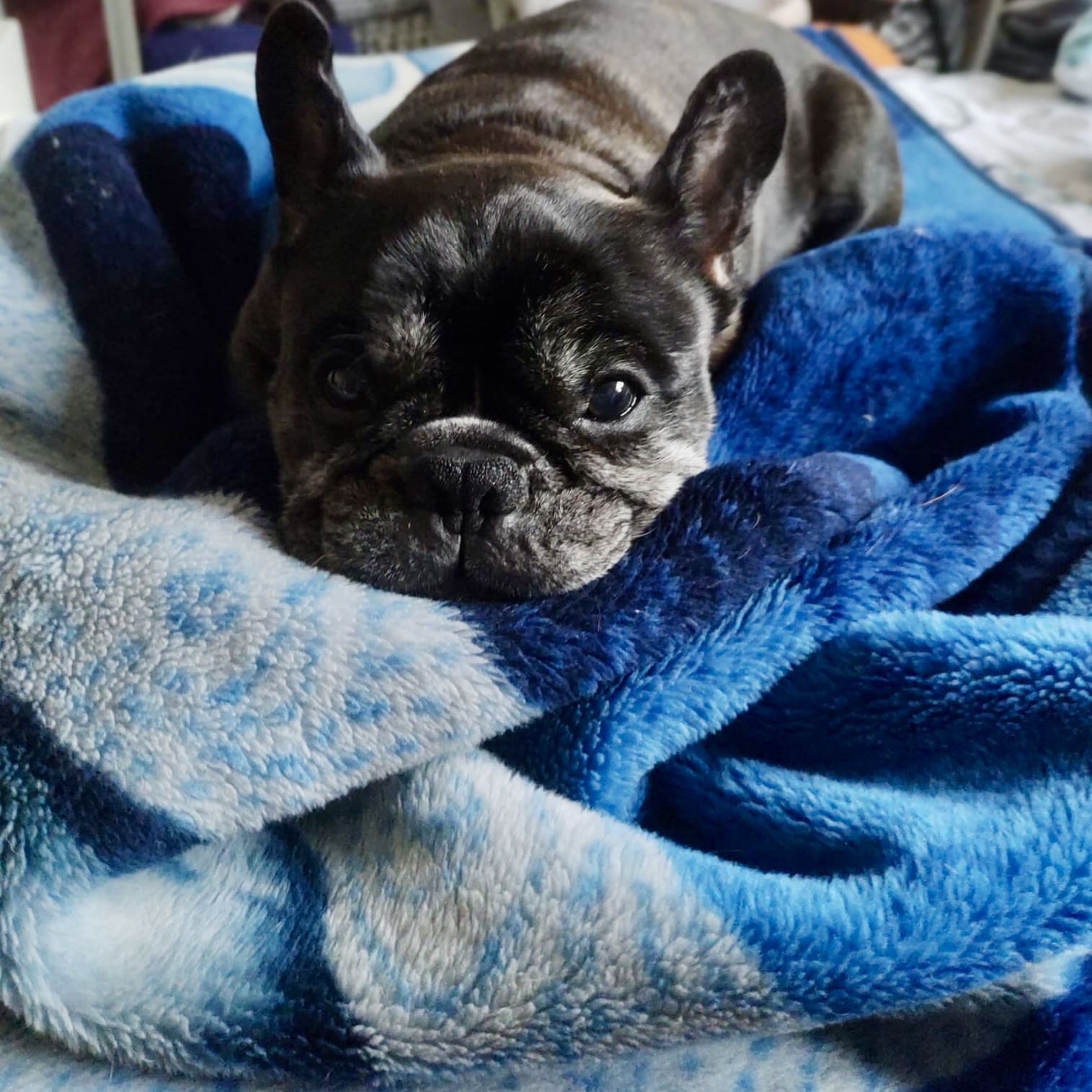
Miyo on his nest © 2024 Surya Ohara
Resilience
End January 2022, a scan revealed two slipped disks compressing Miyo’s spinal cord. Two years prior to this, he was admitted to the hospital as an emergency case for left hemiplegia and underwent an operation. The relapse appeared in September 2021 and, after a semblance of respite, the cervical pain worsened when he fell down the stairs in December.
The vet suggested a more complete scan just because, and it was quite by accident that we found out about Miyo’s large mass in the spleen.
Without delay, he underwent splenectomy to avoid internal bleeding, remove and examine the mass. The lab results confirmed that the mass was a hemangiosarcoma, a malignant tumor classically very aggressive. Thanks to the early intervention, the cancerous cells hadn’t started proliferating just yet, but the prognosis remained grim.
With the chemotherapy Miyo subsequently received – 5 injections of Doxorubicin from early February to end April 2022 –, his survival time was estimated to be 4-6 months max. In early February 2022 as well, shortly before the splenectomy, Miyo had spine surgery.
At the time, it was also found that Miyo had degenerative mitral valve disease as well as a small heart base tumor.
Miyo had regular post-chemo check-ups to monitor his liver and heart and assess the progression of metastases and, much to our relief, the cancer wasn’t progressing as fast as we thought it would. By the end of the chemo, Miyo had a couple liver nodules, probably tumorous cells that, by early October 2022, had gotten slightly bigger. Yet, overall, he was doing fine.
**
When Miyo received his first cancer diagnosis and was declared terminally ill, a period of what one might call ‘anticipatory grief’ started. Often, I’d look at him, trying to soak in all that was him to remember every minute detail, and I’d miss him. He was here and I would already miss him.
When talking about him, I’d switch from the present to the past tense and vice versa. When he’d get a little too quiet and I was at my desk, for instance, I’d glance over my shoulder and would be reassured to see his breath raising his warm, still alive body.
Also, I’d have all these questions running through my head (when I’d mark an event in my calendar, I’d wonder, will Miyo still be here by then? Will we manage a trip before he’s gone?), and I didn’t know how to accept the reality of aborted plans, such as welcoming a rescue so Miyo always had company.
**
By mid-January 2023, the liver nodules had multiplied.
In May of the same year, another cancer diagnosis was in: Miyo had cholangiocarcinoma, a malignant bile duct tumor, with metastases very spread-out in his liver.
Surgery was ruled out given the extent of the lesions and the fact that it was an unremovable mass and that little is known about the best chemo for this rare neoplasm. He was prescribed Palladia to slow down the progression and regular blood tests.
A neck tumor was also suspected, but these tumors are usually asymptomatic, slow-growing, and non-functional, so this was not our main concern.
In October 2024, we went to the vet clinic as the last blood test had hinted at Cushing’s disease, and I also wanted to get his heart checked because of his gradual respiratory problems. The mitral endocarditis had now reached stage C, and Miyo also had light pulmonary hypertension, and more and bigger liver lesions with an increase in necrotic cores. He was to take three drugs for his heart until the end of his life – including diuretics so, during his last months, he had to wear diapers for dogs and a bodysuit when staying alone in the house for more than a few hours.
**
On 20th May 2025, Miyo’s liver volume had alarmingly increased. It had gotten too big for his paws, and he had much difficulty walking and using the stairs. The vet suggested that I contact his internal medicine doctor to ask if he should take Palladia again for his liver as I was afraid it was because he stopped taking it that his health started declining again. Apart from that though, I was advised to focus on palliative care and natural remedies. The vet gave a guarded yet optimistic estimated life of 6 months to 1 year. I felt buoyed by a prognosis I had feared would be much less reassuring.
I scheduled an appointment with the internal medicine specialist, but everything sped up: gradually yet rapidly, he lost his once ravenous appetite and hardly kept any of the food he ate since the previous vet visit. At the same time, his abdomen seemed to be getting ever more distended and uncomfortable.
On 7th June 2025, Miyo was brought to the emergency room. He was lethargic, dehydrated, and had acute anorexia.
He was also presenting with acute neurological and vestibular symptoms: his head was tilting to the right, his eyes were making rapid, involuntary movements and, at this point, he was unable to stand up independently, veering and falling over when helped. During walks, he would turn back to shorten them, go less far, less fast, but that was all: I didn’t think he’d end up unable to walk at all. These signs were likely due to thrombosis, but a brain tumor wasn’t excluded. Miyo had cachexia and severe generalized muscle atrophy.
The vets performed a puncture, removing 1,6 liters from his body. A pronounced amount of liquid was found in his abdomen. His severely enlarged liver had multiple cavitary masses and numerous lesions spread-out over all liver lobes.
The small intestine lymph nodes and both adrenal glands were enlarged as well, and the right kidney had a chronic infarct. His white blood cell count was too high.
The excess fluid had also spread between the lungs and the chest wall, and mainly around the heart, causing his enlarged heart to need extra efforts to pump blood. Miyo was presenting with severe mitral insufficiency. His heart was beating too fast and making muffled sounds like his lungs.
Miyo was supplemented with oxygen throughout the stabilization process, and transferred to the cardiology, internal medicine, and neurology departments.
24 hours after his admission to the hospital, there was no sign of improvement. Miyo still had no appetite and placing a feeding tube was considered to ensure water intake. He was still unable to walk and was breathing faster.
Because of his medical history and clinical condition, the imaging findings and multiple comorbidities and a life of poor quality and suffering which I knew for certain I didn’t want for him, Miyo was put to sleep on 8th June.
It was by far one of the hardest decisions I’ve ever made, and this decision haunted me. When Miyo was put to sleep, I lacked the clarity of mind I hoped I would get: was euthanasia the right choice or should we have done the IRM to rule out the brain tumor? I would have been up for a groundbreaking chemo or treatment, anything to keep him with us just a few moments more, as long as he could walk and eat again and live a good life. Rereading the final report though, I realized it was the only humane choice: his own body was attacking him from all sides.
**
Miyo went on to live 3 good years after the chemo, faring better than anybody could have predicted. It was both a blessing and a curse that he couldn’t understand everything. He endured it all standing tall. The epitome of resilience.
Those 3 years included many ultrasounds, scans, blood tests and other medical exams; regular visits to vet clinics; hearing variants of “We’ve administered him (unintelligible). What’s ailing him is (unintelligible). He’s staying overnight for us to check (unintelligible)…”; as well as remission, hope, lost hope, and intensive home care.
However, those were but a tiny speck in the picture: against all odds, for so long, Miyo’s health condition remained stable, and he showed no symptoms except for minor digestive issues and tiredness at times. The cardiologist said she’d never seen that in her long career, and his internal medicine doctor knew only one or two such cases. He was one of the miracle survivors, defying statistics, and was in the hands of extraordinary vets.
Miyo lived a happy life he loved dearly. That’s the memory I wish to hang on to.
In an ideal world, he would have lived in a stairless home, never overdone it, and so forth, but it was important for me not to overprotect him. Miyo knew how to cater to his own needs by, for example, instinctively positioning himself in a certain way to lessen his pain, and I would listen closely. Also, I wanted him to enjoy life rather than merely survive.
For his birthday following the first cancer diagnosis, we spent the day in the woods. He needed more rest to recover after that, but he got to play with a dog, spend quality time and share ice cream with loved ones, walk among the trees, and I fondly remember his eyes sparkling with gratitude and joyfulness.
Comical Moments
Miyo didn’t have a mean bone in his body, but there was an impishness and an irreverence about him.
He would do anything for food – try to steal food straight from your mouth, standing on your lap, or another dog’s; perform all his tricks at once; help himself directly from someone’s plate. He once ate an entire plate of faworki my mother had spent two hours making and all the French fries waiting at the table intended for my brother. The thing is, he was remarkably skilled at jumping high and might have learned from the cat he grew up with how to do that and walk on tables.
That skill put him in danger once in particular, when my apartment got flooded. My mother was staying over that weekend, and we left Miyo alone in my apartment for just about an hour. When we came back, the hot water in the kitchen was turned on to the maximum. We found objects down the sink blocking the sink drainer, several centimeters of water up to the entrance, under the furniture of course, in the drawers. The cooker’s red light kept flickering for days. To this day, I don’t know how he managed to jump this high, and we had pushed the chairs because we were aware of his habit of hopping and going where he wasn’t supposed to because of his separation anxiety. We spent about 2 hours repairing the damage and emptied over 7 buckets. Dozens of liters of water running. Good thing we weren’t out for longer and what a relief Miyo was safe!
He once ripped apart the gift to my sister’s dog Rocco, the toy’s plush guts sticking out, in front of Rocco’s helpless eyes, before he even had a chance to play with it.
Often, when one of us was standing, he’d put his paws on our legs and adorably yet blatantly grab this opportunity to stretch and use our body as support for his stretching.
Also, he seemed to know how to time his farts to interrupt a could-have-been romantic moment, break an awkward silence, or loosen up a professional video call. He had a knack for preventing moments from turning too serious or sappy.
During walks, he’d lie flat on his stomach every time he’d see walkers with dogs, do commando crawling, sometimes hiding in a bush, and then get back up in a lightning-quick movement, startling them. Or a stranger would want to pet him and after a few seconds change their mind because Miyo’s hoarse bark would contrast with his cute face. He came to be known as a little terror in the neighborhood. I would apologize on his behalf, while often keeping a giggle inside.
In public transportation Miyo was a far cry from the way he was in the streets. He was super-calm, would gently approach passengers and let anyone pet him – except maybe train controllers.
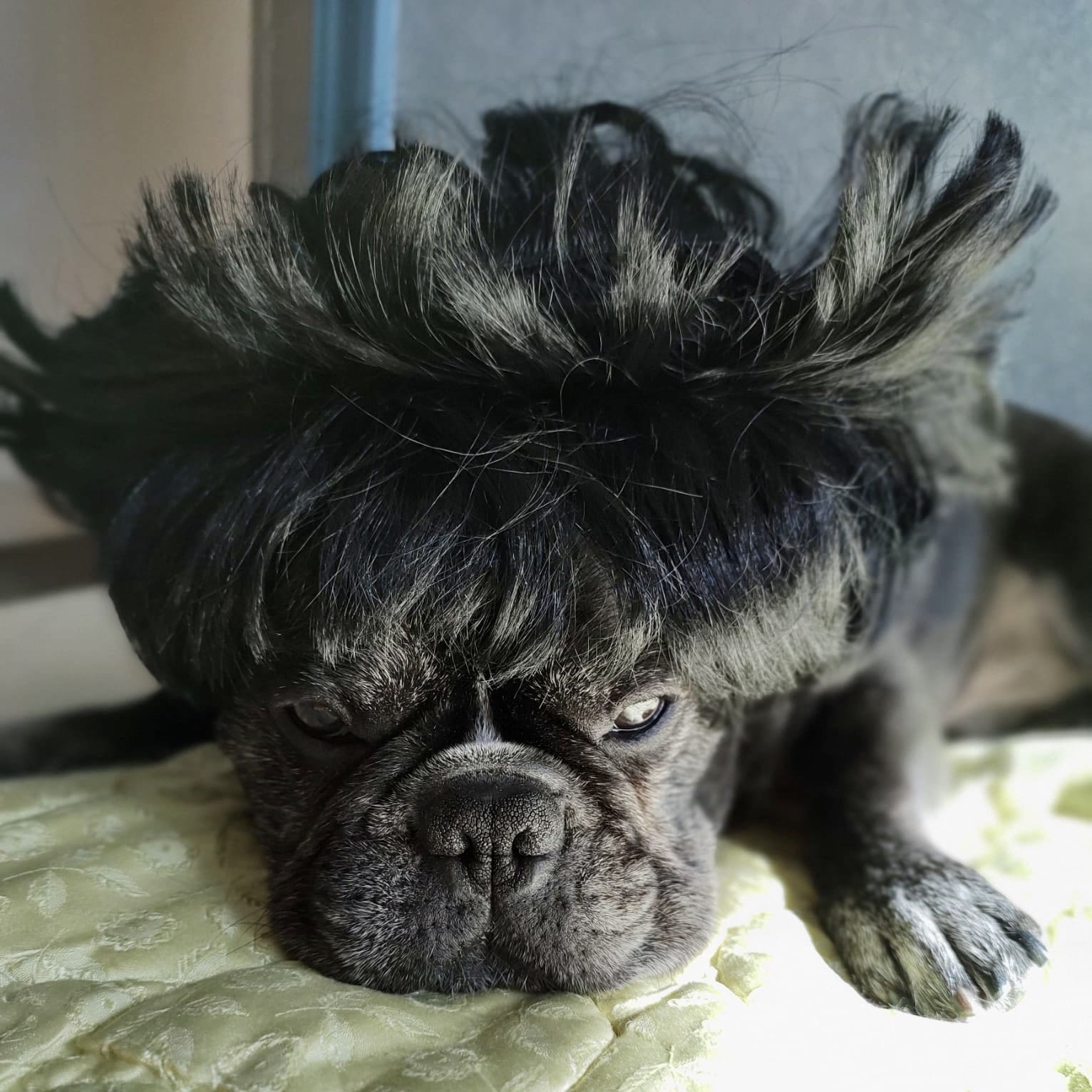
Miyo on a bad hair day © 2022 Surya Ohara
Miyo was a study in contradictions in other ways.
He got along with all female dogs throughout his life but was a bit of a troublemaker with males. Although he was not one to attack, he was attacked a few times. As he became older, he mellowed out a lot. And he was shy in groups, for example in dog parks.
He hated walking in muddy puddles but once jumped into a pond. I had a job interview in my sister and her fiancé’s city, and they took Miyo on an excursion for the duration of the interview. When they came back to pick me up, Miyo was on the backseat, a towel wrapped around him, and they told me the story of how he almost drowned amid swans and my sister’s partner leapt into the freezing cold lake to save him!
With his melancholic eyes and clownish antics, Miyo knew how to keep life colorful, how to keep it both light-hearted and meaningful, funny and bursting with big emotions.
Why Dogs’ Wordless Wisdom Makes Us Better Humans
“Will you adopt me?” the note on my 22nd birthday read. With it, a photo of a face I already loved. And just like that, I was propelled into a life with undreamed-of joys and new responsibilities.
My siblings and I learned to care for pets as children, but this was a whole different ball game. I was 20 when our dog Gus died at the age of 19 and have no recollection of him as a puppy. This time round, I was the one in charge of a dog’s education, and it wasn’t smooth sailing! I was a university student then, with still one year to go, and Miyo would sleep on my lap while I was studying for exams.
It was a formative period in many respects, and Miyo went on to stay by our side for over 12 years. Little did I know of his wordless wisdom and how much he would change my life.
Miyo, as dogs do, lived fully in the present. Calculation and overthinking were not part of his life philosophy. He would greet changes of plans with gladness and a sense of adventure and agree to stop doing what he would be doing, saying Yes to wherever we had to go and whatever we had to do instead, allowing life to take him in this or that direction. I admired how open he was to surprises, how serene he appeared in the face of tomorrow’s uncertainty.
I loved the way he would lift his head to better feel the wind on his face or pause to listen to the birds or smell a flower, how he would consider all the living things he’d encounter. He lived life to the full: he never did bucket-list-worthy things, but what I mean is he didn’t do things half-heartedly: he mastered the art of savoring. Miyo wouldn’t tire of the ordinariness in life: each walk was a new experience, each morning a morning he hadn’t yet seen and, for that reason alone, exhilarating.
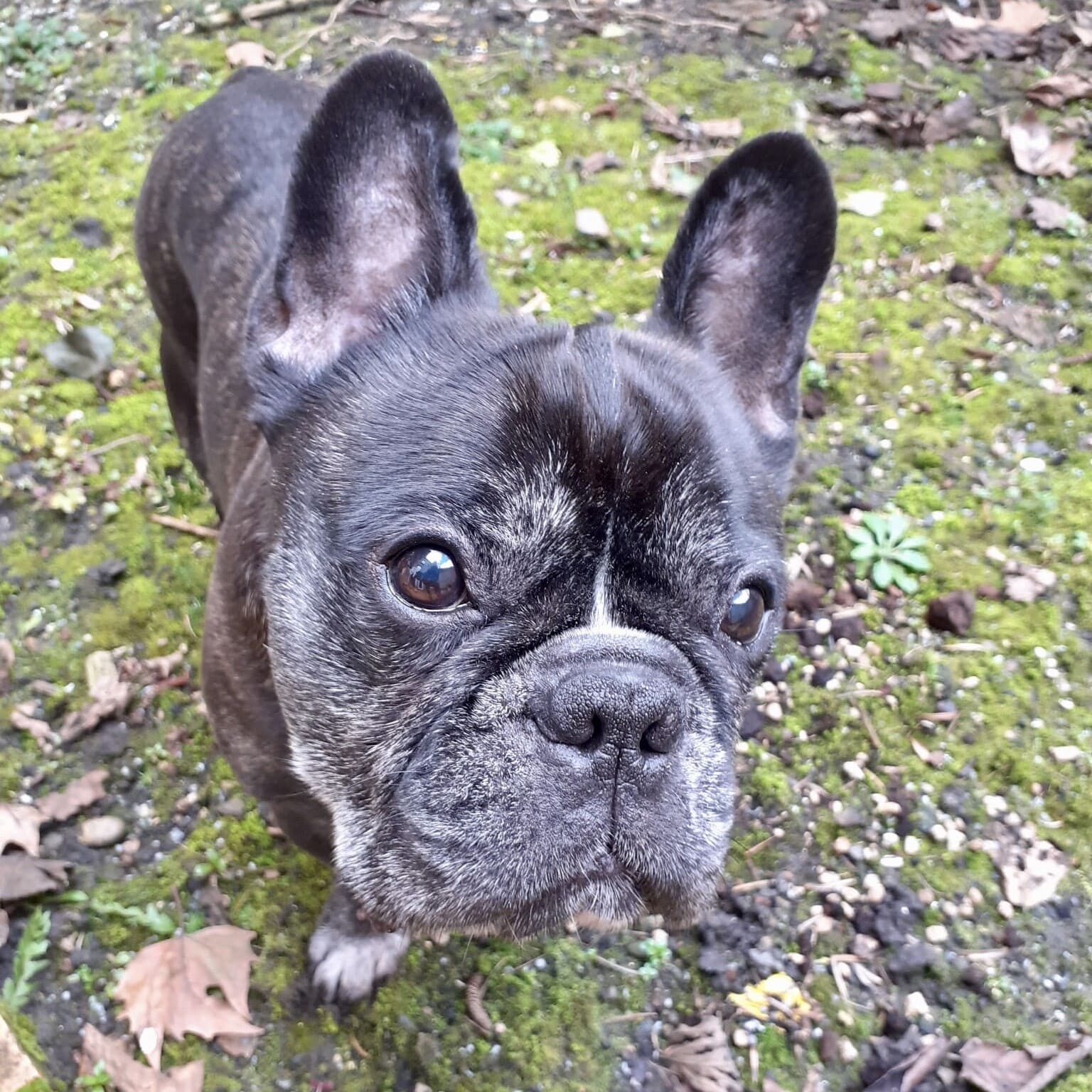
wordless wisdom © 2023 Surya Ohara
He never examined joy: he felt it. Dogs don’t ponder life’s big questions but impart to us myriad lessons by simply living, opening our hearts and eyes to the beauty of the world and to the important things no other source of information could have explained more eloquently. Dogs teach us by example, by being, and show us, time and again, that every minute of an hour doesn’t have to be spent doing anything. Dogs just are, and it is enough. They can be our shelter from the world in tough times, but they also gently force us to venture into it every single day.
They’re big on instinct. The word spontaneity comes to mind, and I cannot talk about what Miyo taught me without touching on this quality he had in spades: Miyo was spontaneity on four legs. He would want to get into a vehicle or a house that wasn’t ours simply because the door was open. “A door is open, I’ll go in,” he seemed to think. This has me believe that – although Miyo was fiercely protective of his beloved pack, defending us even when there was no need to, and if you were outside of his pack, you had to earn his trust – to him, the world was a friendly universe and every place a safe, welcoming space. And, oh my, was he curious, too!
Dogs enjoy the simplest pleasures, but no joy feels as contagious to them as their loved ones’ joy. If all is well in their humans’ world, they’re happy. They’re so responsive, so impressionable in a good way: if you act happy and playful and speak in a cheerful tone of voice, they’ll prance around, wag their tail and play along, even if they don’t quite understand what it’s all about. I find this permeability endearingly moving.
They don’t know or care about what they look like and this lack of fussiness about appearance extends to us. Many of us look at their own reflection several times a day – in mirrors, our phone screens, car windows, and the like. It wouldn’t be fair to call it vanity. Rather, the trouble might be, deep down, we tend to think looking good and healthy enough is a precondition for being loved.
Miyo used to run upstairs after a walk. When he became ill and old, he was able to recognize his limitations without shame and would wait to be carried if he needed to. Of course, he didn’t have to ask me to take care of him, but it was a given I would. Whatever his state of health or his appearance, he wasn’t afraid to take up space and knew, with absolute confidence, that he was worthy of help and of love.
Which brings me to perhaps the greatest lesson dogs teach us: what it’s like to give and receive unconditional love. Many of us say that they share with their dogs a pure, generous, uncomplicated love they haven’t known with a human being, that dogs love with a steadfast loyalty that is unmatched. Over any other human, your dog would choose you every time, even if no-one else might, simply because you are you.
We naturally find a common language devoid of puzzling silences, long-held grudges, hidden agendas, pretenses and other barriers that often hinder human-to-human communication. With dogs, it feels easier to reach a deep, wordless understanding.
Dependable Compass
Miyo never asked me to be anything other than what I was. Dogs meet us where we’re at, accept us the way we are, flaws and all, and they’re right there through joys and sorrows.
When I’d binge-eat to numb my emotions, he’d partake in the sad feast. When I’d watch television as a way to procrastinate yet again, he’d lie down by my side. He watched me fall for men who were bad news and inevitably pick up the pieces of my broken heart. Miyo was a protector and a comforter, but he didn’t have much patience for tears. He wasn’t a fixer. Rather, he’d do things in a spirit of solidarity.
Miyo was a trusted compass amid the uncertainty of a life pulling us in all directions. Reciprocally, a creature of habit, as dogs are, he counted on me, too, to maintain a daily routine and points of reference without which he was a bit lost.
The days spent in each other’s company would blend into one another and perhaps our different perceptions of time accentuated that feeling. It was lovely to have a space where the basic, rudimentary things are what matters: being attentive to his thirst, hunger, tiredness and making sure he took his meds; rejoicing in watching and hearing him drink, eat, sleep; staying close to one another; going for walks at such-and-such a time. This consistency would bring me reassurance. The established peace often felt like the only constant in an ever-changing world.
When you spend so much time with another being, you end up knowing them so well – the different looks and postures and their meanings, the hints and subtleties – and you build a strong connection.
Among other things, I knew by heart Miyo’s various swirls in his fur, his special fondness for strokes and scratches between his ears, at the base of his neck, and of at the base of his spine, and the difference between the way he would drag his paws when weaker and the way he would do it when sensing I was going to be away and he didn’t want to be home alone.
His inquisitive eyes soaked up our moods and everything else, too. There was no hiding from him: nothing would get past him.
Though the signal would at times change (putting the sponge back after doing the dishes or, say, a final makeup touch), he would invariably know when I was about to leave the room, standing in the way for me not to go. He was sensitive to my slightest moves, even at a distance, it seemed. My mother once told me Miyo went downstairs and stayed by the door five minutes before I came home and inserted the key. He could feel me getting nearer.
**
Maybe particularly as a childless, single person, you feel the bond with your own dog is so unique because, throughout the years, your dog comes to fulfill the roles of both parent and child, and you look after each other, offering mutual protection and care.
I would feel a constant tug and pull, both excitement about going out and worry and guilt over leaving him alone for hours. I’d look forward to taking a breather or some me-time but miss him as soon as I’d shut the front door.
I considered Miyo my forever-baby. That might be why, while I knew it’s normal for our dogs to die before we do, when he died, the idea of me outliving him didn’t feel quite normal.
His complete faith that we always had his welfare at heart always moved me. When he’d have to keep an empty stomach for half a day before a medical exam, for instance, the wait wouldn’t deter him from being his usual loving self; he’d endure it with great patience.
He’d stand by us in sickness, too. We’d call him ‘nurse Miyo’ because whenever one of us had a stomach- or headache, the flu, what have you, he’d lie on the sick person with all his weight, as though nursing them.
I watched him grow up, and then I watched him grow old, go gray, develop a stoop, saw his nose slowly begin to lose its smoothness and old age start to show in other ways.
It wasn’t he and I against the world though. Miyo was in symbiosis with his ‘granny’ and ‘auntie’ who were his human moms, too. When I left the family nest, I took Miyo with me, but he was expelled, if you will, from the first apartment, and then the second one, because he’d howl for me while I was at work, bothering the neighbors. He was attached to the home where he spent the first years of his life and to his granny to whom he only grew closer with the passing time. He was happy to move around as long as it was temporary: that’s the home he most wanted to guard, and I had to come to terms with the fact that I had to split my time between two homes: my apartment and my childhood house. I’d go to the latter every week and stay for several days – most weeks, I was at this house more than I was in my apartment.
Gratitude
I regret being only half-present sometimes, not reducing my screentime often enough to dedicate more time to just being with him.
Another big regret is failing to ease his fear of strangers – we should have spent more time in crowded places, I should have introduced him to more people and dogs… – and of abandonment.
It would break my heart to leave the house, knowing he’d be waiting by the door, watching out, guarding the house, fearing. He lived for us. I was told his mother Lola, the dog of my sister’s friend, used to hide him in the closet, in corners, in a big pile of dirty clothes, maybe to protect him because he was the frailest one of the pack, and she’d sometimes forget him there. He was taken away from her early, too – at about 7 weeks. Maybe that played a role in his fear of abandonment, but the first months with me as his guardian were key and I wish I’d done a better job.
I tried different things. Playing relaxing music for dogs for a time. Taking agility classes with him for him to socialize and listen better. Seeking help from a dog behaviorist. One of the things I implemented was to act as serenely as I could when it was time to leave, to not rush or make a big deal out of a goodbye for him to absorb calm rather than stress. None of these things truly helped.
In one agility exercise, I had to hide behind a wall – was it stacked bales of hay? I don’t know anymore – and Miyo had to wait calmly before we could reunite. Today I wish we could reverse the roles, that it could be him disappearing and reappearing before we reunite once more in a kind of festive embrace.
**
I’m glad I knew what I had when I had it, though. Sometimes, I’d look at him from across the room and find him so cute that I’d rush to cover him with urgent kisses, my heart bursting with love. I’d cover him with ‘I love you more than anything in the world’s, too.
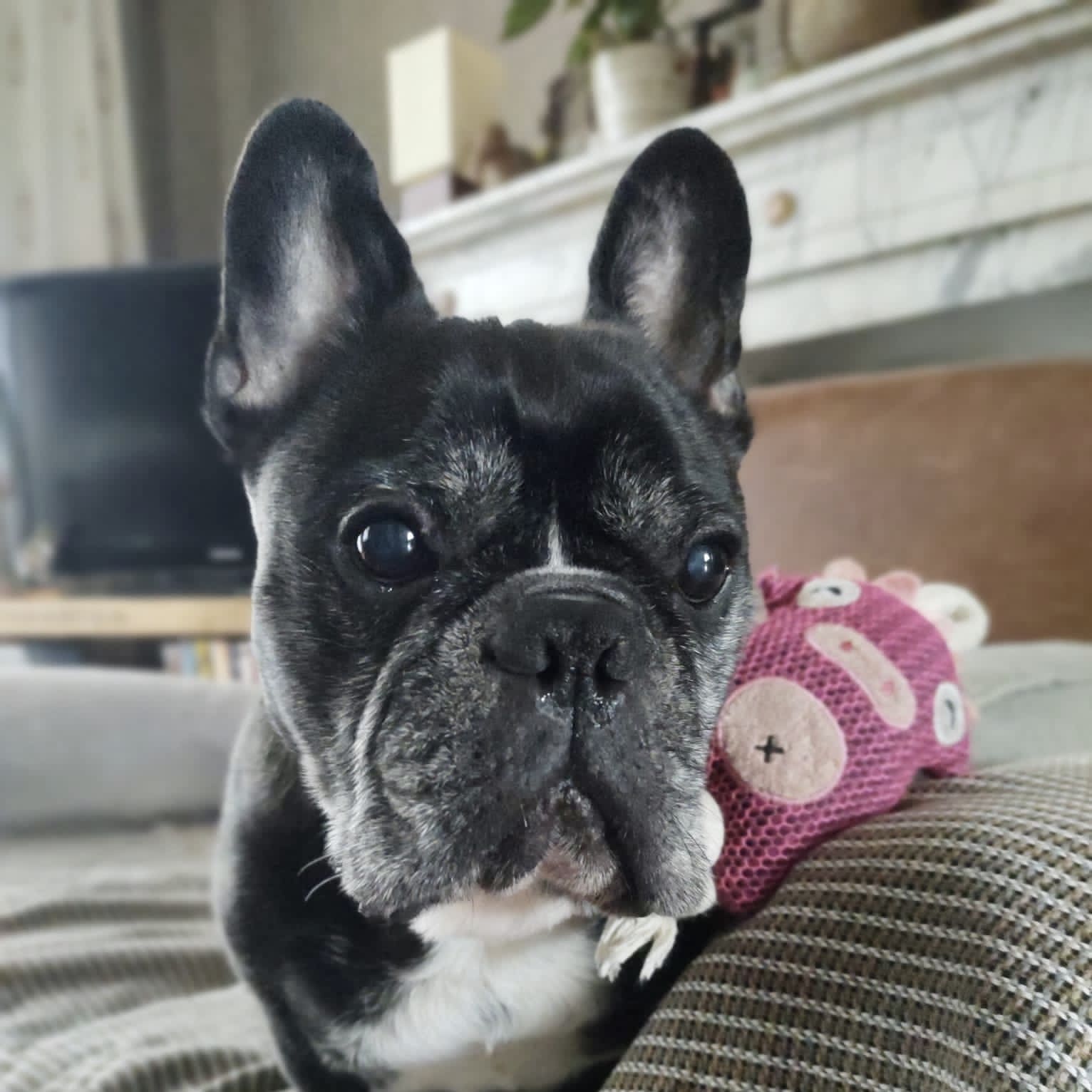
Miyo’s sweet little face – © 2023 Surya Ohara
Rereading the gratitude journals I’ve kept over the years brought me to tears: I was struck by how omnipresent Miyo was.
The same things reoccur: his tenderness, his spontaneity, his love; reuniting after work, after 24 hours, 48 hours; spending the day with him, being near him, knowing he’s home, sheltered, happy; his strong bond with ‘granny’; watching him play with immense joy; hearing his peaceful snore, sound asleep; getting to kiss and cuddle him; seeing him search for my presence, seeing him happy to see the rest of his people. Sometimes I simply wrote ‘Miyo’ with a heart next to it or on the ‘i’. No day in my life could be entirely bad as long as he was in it.
The last entry dates back to the day before his death, 7th June: an unfinished list, a star-shaped bullet point with nothing beside it. Time stopped that day.
A few weeks before that day, my journal was overflowing with gratefulness for him and towards life. I wrote I found him lively when I got home, we shared food, I hoped to get to look into his eyes for as long as possible still. I loved having Miyo near me, getting to bask in his presence and to see his adorable face, his big curious eyes, his joy when I gave him what would be his last toy – a plush seal I share my nights with every time I visit my mother and sleep over at my childhood house.
Last Moments
On the days leading up to his death, he rolled on his back on the carpet, slept with his belly up, carried twigs and sticks during walks, which he hadn’t done in a while. This resurgence of vitality had me hope for a second wind, a remission. Were these his last presents to us? Was he holding onto life?
Do dogs sense it, when the time comes for them to go? Miyo waited for our return from our family trip to Sweden to let his body give way. He died a week later, on Pentecost Sunday.
After our last walk together, I removed a tick from him. I bought hooks at the pharmacy and carefully kept them for later: it was the season. I didn’t know he would no longer be here in summer. Then, that day, I lied on his orthopedic mattress and nudged him to lie beside me, to cling to his presence a little longer before going to my apartment.
After vet visits, I’d have a little bag of food for him to snack on, on the way home. This time too, we’d prepared his return home from the clinic. I saw a couple happy and relieved to get to bring their dog back home, and thought back on the times I got to do that, with a nagging sense I might not have this chance, this time. I remembered the vet’s words after his second spine surgery “Good news! Miyo has appetite, is walking, running even … you can pick him up earlier than expected!” I had come to believe he was invincible: he always bounced back, why would it be different this time?
Over that weekend when Miyo was hospitalized, I kept anxiously waiting for my phone to ring, hoping for the best, against all odds. The miracle call didn’t happen, not this time. The specialists called one after the other and spoke with one voice: you must prepare for the worst.
I knew his days were numbered, that all we had after the chemo was just bonus days, that we had to gladly take what was being offered to us. But even so, when the time came to say goodbye, I felt caught off guard. I had dreaded this moment for so long, wondering how the end would happen and erasing the scary scenarios from my mind, and here it was.
His head was near mine, the way it always was during usual checkup visits when I’d be gently holding him and caressing him, whispering that I was here and how proud of him I was and what a brave dog he was.
I held, stroked, kissed him, thanking him and telling him I loved him, again and again until it became a blur and he couldn’t hear me anymore. I hope he could feel the outpouring of love from the whole family and that he knew we did everything we could to keep him by our side for as long as possible.
We watched his breathing slow and cease. A heartbeat before, a breath before, he was alive. We left him where he lay, and I stood by the door for a few seconds, looking at his back, the plaid that wasn’t his, the plush toy that looked like a bigger version of his very first one – a duck or a goose, I’m no longer sure. Things to soften the blow, but it made it all the more heartbreaking, this pairing of innocence and death. I waited for him to turn around, but of course he didn’t.
The last hello, the last strokes, the last…, the last… The first night without him in the world. The first morning, waking up and forgetting for a few fleeting seconds that he is gone. The first summer without him.
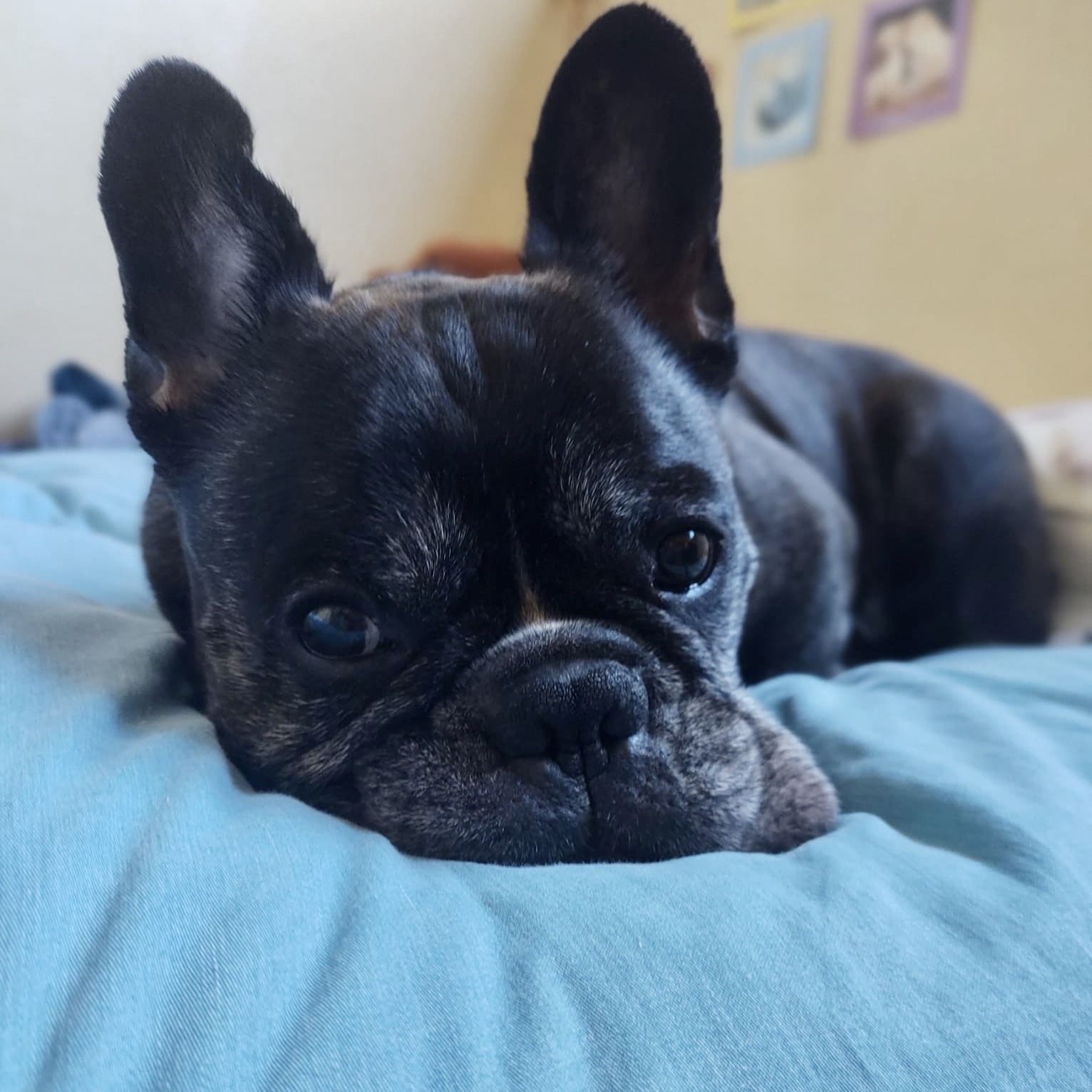
a well of softness – © 2023 Surya Ohara
Strange Empty Space
It feels strange, when your world has just crumbled, that everything around you goes on, as if nothing has happened. Dogs, because of their effusiveness and infectious joy, make our whole life expand and, when they’re gone, the days seem to shrink, stripped of an essential part.
The rhythm we’d created had become so familiar that, with him gone, everything in my life felt foreign. I used to plan my days and weeks around him and, for once, had too much time on my hands. It still takes some getting used to, to get rid of old automatic reflexes: no precautions to take so Miyo doesn’t fall down the stairs, no walks three times a day. I can wear perfume again – Miyo was sensitive to highly scented things.
The house now empty of him feels less like a home. The ceilings look too high, the rooms too big to accommodate the heavy silence that has set in. There’s the void inside, too, the physical pain of grief, the ache in the heart and stomach. And then the inability to speak of the loss without a quavering voice.
Cherished Crumbs
What stays cuts deep and brings comfort – the wood appearing under the paint on the dining room door he used to scratch when it was shut; the polaroid where he discovers snow for the first time, his whole life ahead of him, a moment frozen in time… I’m not ready to linger over his pictures, but it’s a consolation to know they’re there.
The night I said goodbye to Miyo, I slept against his blanket and his hot water bottle. I breathed them to etch his smell in my mind. I have kept his crummy old chewed-up toys, his plaids, his washed bowls, his harness, his vaccination card, his passport. I can’t bring myself to throw away any of his stuff. Yet I know that, over time, they will smell less and less like him, that I will keep losing him bit by bit.
Miyo was cremated in a peaceful place with nature nearby, and as my brother was driving me to the crematorium, a part of me believed we were on our way to visit him, that he had just moved house. Picturing him in the cold room was difficult, so I was glad he was no longer in it. I clumsily took the prearranged bag with his ashes in a mosaic urn, the certificate of individual cremation, and a frame with his pawprint and a little tuft of his black, white and sandy hairs. Back in the car, tears streamed down my face. It was as if he had died all over again. Twelve years of life and love contained in boxes in a bag.
Suddenly, these material things become reminders of a past together I will forever treasure, precious crumbs of comfort.
A Love Letter to You
Whenever people hugged, Miyo would place himself between them to take part in the hug; when someone was playing with another dog, he’d tag along, inviting himself. At a birthday party or a big family reunion dinner, he’d stay at the table with everyone, even as his eyelids were getting heavy and the couch a few meters away would have been a more comfortable option for his sleepy self.
Miyo was adorably clingy. He couldn’t stand being left out or alone. So, it’d be only fair to close this post addressing him.
Mi, thank you for these 12 wonderful years in your presence. If I could live them all over again, I would. I wish I could have but one more day with you. At the end of it, I still wouldn’t have had enough of you, though. I miss you so much…
I hope that heaven is as magical a place as we’d like to imagine it to be, that you’re reunited with Murr (Nuage), Robbie, Baloo, Pepito, Kiah, Lola, and have met Milka, Gus, dad… When I see a dog running as fast as their legs can carry them, running like the wind, I think of you, and hope that you are now just as free and happy.
Remember your first plush squirrel, the first toy you played with, refusing to let go, even to drink or eat? I can’t help but see it as a wink from you, when I saw two squirrels in the early morning one day as I was thinking of you. I hadn’t seen any in such a long time. I’d like to think that you’re watching over me, that you can shape shift, temporarily reinhabiting a more earthly reality before going back to your heavenly home, that one moment you’re a squirrel, the next a pigeon, or a butterfly, that it is you behind a stroke of luck, a happy coincidence, a playful gust of wind, a very bright moonlight, a breathtaking sunset.
Was it you, on the road going home? After we said goodbye, Shin said, ‘hey, look at the sun’. It was beginning to set, and I had never seen anything like it: a bright red sun against a pale sky. I’m sure there’s a rational explanation, that it was likely due to the smoke coming from forest fire on the other side of the Atlantic. Still, I can’t do without magical thinking for the moment.
I used to wonder, how will you get by in heaven, when I’m no longer with you? Who will care for you up there? I know it’s silly. And I know you won’t be found in tangible form in this life anymore. But still, when I push the front door of our family house, a part of me still thinks you’ll suddenly appear behind it.
I will be seeing you, in all the parks we walked in together, in every animal that bears some resemblance to you, in the serendipitous appearance of a rainbow as I’m rinsing the dishes in the sink. I will be hearing you in another dog’s bark.
My heart will be carrying you everywhere I go, for I promise I will keep you safe in it until its last beat. This is not the last time I shall talk to you before we meet again, so let me just say bye, for now. I will never stop loving you.



Un hymne à la Vie. À l’Amour.
Merci de partager ce bel hommage.